Why I built
Wingman Mail
A decade of Inbox Zero, four email clients, and one cousin who got tired of listening to me complain.
 Arturs KruzeFounder, Wingman Mail
Inbox Zero worked.
The overhead didn't.
I answer email for a living — most founders do, whether they admit it or not. For years my system was Inbox Zero in plain Gmail, taken to its logical extreme: multiple inboxes, one pane for every kind of commitment. Action Needed. Awaiting Reply. Scheduled. Delegated. Long-term Backlog.
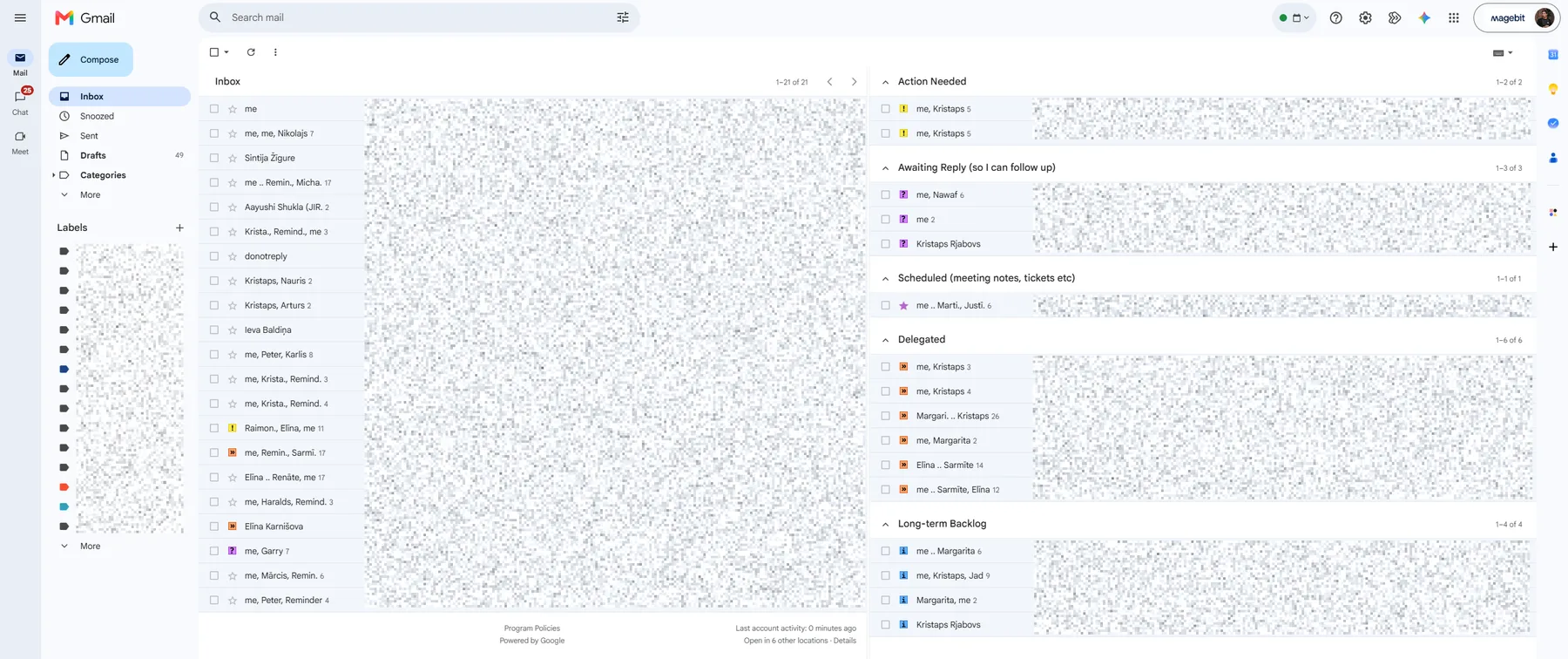
And it worked — nothing ever slipped. But look at that screenshot for a second. That isn't an inbox, it's a control panel. Every message that arrived had to be read, judged, and hand-routed into the right pane, dozens of times a day. The system kept my projects on track by outsourcing all of the tracking to my head. Email was handled; I was exhausted.
Then I found Superhuman, and it genuinely felt like a golden find. Real keyboard shortcuts, split inboxes, triage that took minutes instead of an hour. The only catch was the price tag — it was, and still is, expensive email.
Great, until it
stood still.
For a couple of years, Superhuman was the answer. Then Grammarly acquired it, and from where I sat, the innovation simply stopped.
The timing could not have been worse. This was exactly the stretch when AI was getting dramatically more capable every quarter. I watched models learn to summarise, draft, and reason about email better every single month — while my email client shipped almost nothing that used any of it.
So I stopped waiting. I wired my mailbox into n8n and built triage automations around the client. When n8n's nodes became the ceiling, I threw them out and wrote custom automations so nothing limited what the AI could do. By the end I was effectively running a second, invisible email client in the background: my own AI doing the thinking, Superhuman doing the rendering.
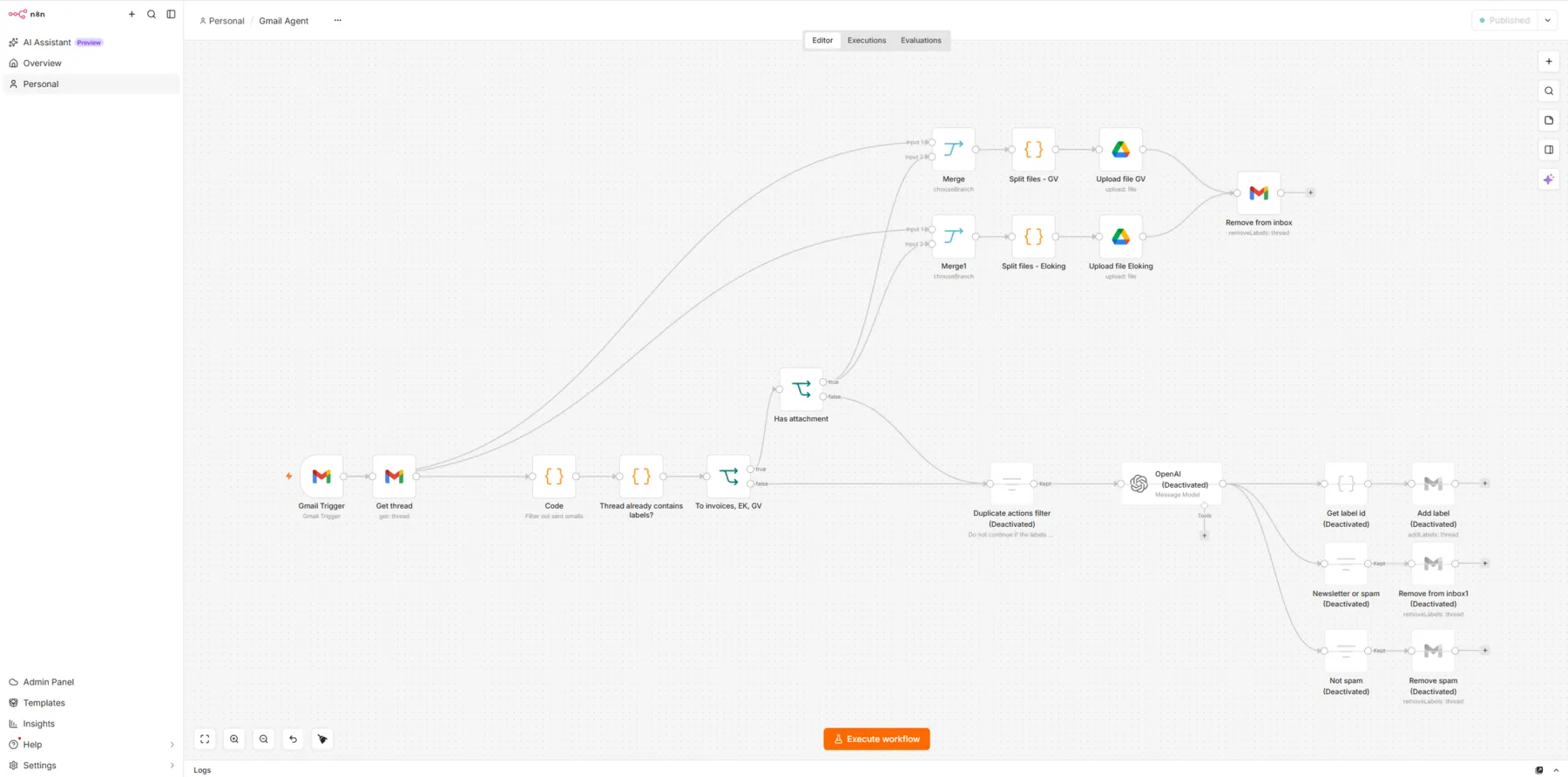
Even with my own AI,
the walls stayed up.
My custom triage bought me a lot. But I was still living inside Superhuman's product decisions, and I kept hitting the same walls in the same places:
- Memory that forgot. The AI barely remembered anything about the people I write to every day, and there was no way to see or correct what little it held.
- A voice that wasn't mine. Tone matching fell apart the moment I left English. My Latvian drafts read like a tourist wrote them — and half my mail is in Latvian.
- Reminders I never asked for. Auto reminders scheduled themselves on sends where I wanted none, so the nudges I actually needed drowned in ones I didn't.
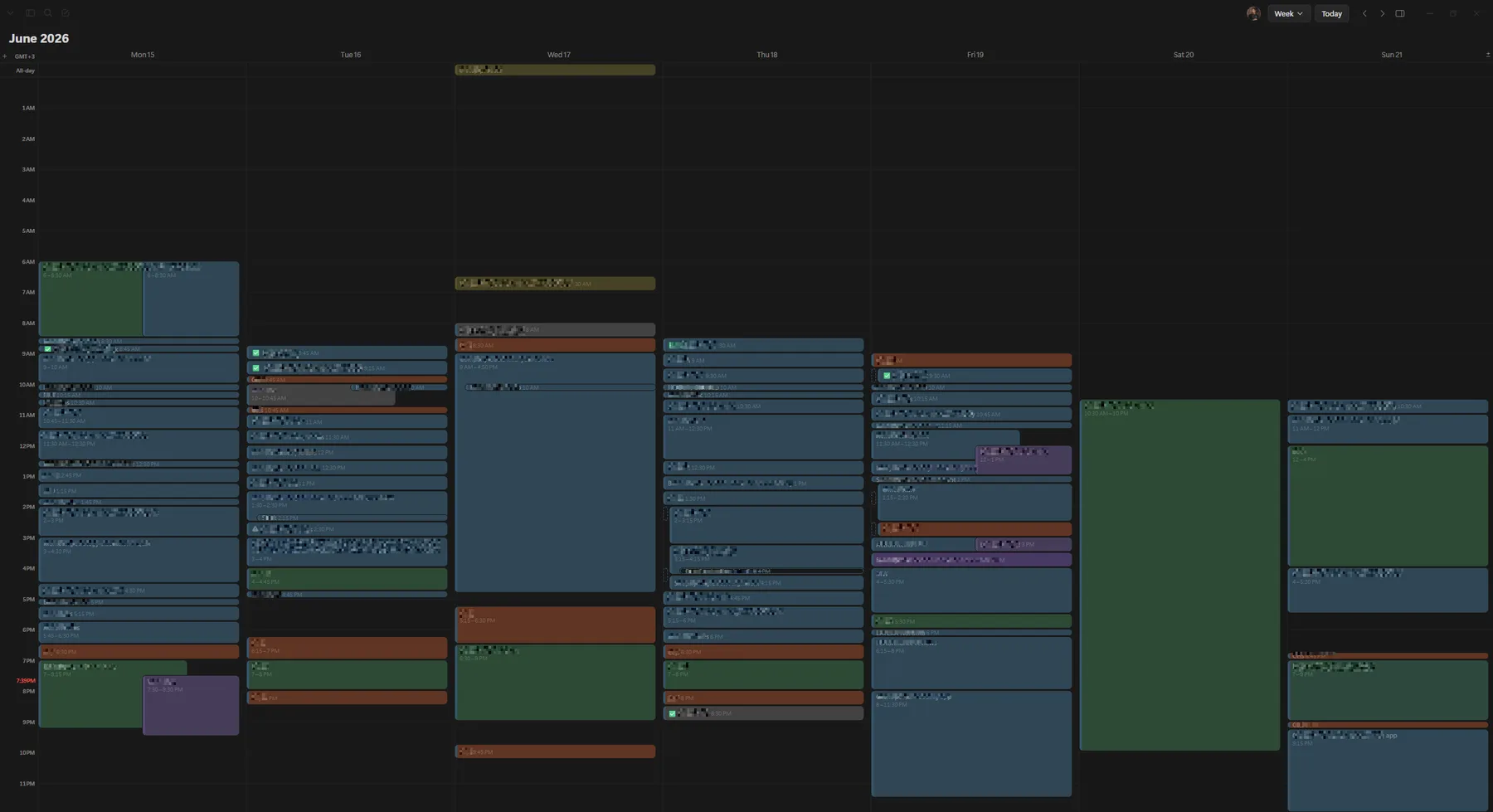
- A calendar that lived somewhere else. I started on Google Calendar, then tried Superhuman's — and it was terrible for my needs: no color coding, no multi-account integration, no one-off scheduling links with personalized availability. I ended up on Notion Calendar, which isn't terrible — but it's yet another app, and it doesn't talk natively with my email.
The complaints became
a list of what-ifs.
By this point I wasn't writing feature requests for somebody else's roadmap anymore. I was keeping a list on my phone, and every entry started the same way:
-
What if I could click to the right of an email to mark it done — and to the left to go back?
-
What if all my mailboxes lived in a single view?
-
What if the first recipient landed in To — and everyone else slid into Cc on their own?
-
What if everything I'd open next was already rendered, making every interaction instant?
-
What if a potential scam carried a caution sign — and the government a gray verified mark?
-
What if auto drafts pulled from company docs and Slack, so the reply already knew the answer?
-
What if I could see every API call the app makes, so I know exactly what the AI touches in my email?
-
What if it cost little enough that I could onboard my whole agency — all 150+ of us?
What if I had a wingman — and a mail client that did all of that? Not another inbox with a chatbot bolted on, but something that actually flew alongside me. The list kept growing, and no app on the market was going to build it.
The right AI,
wrapped in friction.
Then Slashy came along, and I was genuinely intrigued. One view to manage all my mailboxes — exactly what I had wanted for years. And the AI was, honestly, superior to Superhuman's by a wide margin: it could connect custom MCPs, it could reach into iMessage, it could actually do things instead of just writing text.
But the UX was not great. I sent over bug report after bug report, and to their credit, many were fixed. Day to day, though, the product kept generating friction — small stumbles and rough edges that add up fast in a tool you live in for hours. Eventually the friction won, and I switched back to Superhuman.
None of this comes from a lack of respect — quite the opposite. Rahul at Superhuman truly cares about the product: I've spoken with him countless times, joined the early programs, even sat in on calls with their design team. And Harsha at Slashy has been just as eager to improve things across our many discussions. But I spend so much of my life in email that no matter how involved I get in giving feedback, the products they're building simply won't become the one I need.
Which left me with the worst of both worlds: missing the AI that Slashy did brilliantly, back inside Superhuman's walls, still babysitting my own custom automations on the side. That is roughly when I complained to my cousin Chris. Again.
“Just build the damn thing. You've been complaining about stuff like this for a year already.”
— Chris
So I built
the damn thing.
Chris was right, and a year of complaining turns out to be excellent product research. By the time I wrote the first line of code, the vision wasn't “a bit better than one of them” — it was better than all of them combined:
AI beyond Slashy
Drafts in your voice, memories you control, plain-English automations that finish whole jobs, and custom MCPs — without the bugs standing between you and any of it.
Cleaner than Superhuman
Minimal, keyboard-complete, and instrumented: every interaction is measured against a sub-100ms budget, so convenience is a number, not a vibe.
Private like Gmail
Superhuman and Slashy are quiet about what happens to your mail. Wingman's default tier syncs your device straight to Gmail — our servers can't read your email, and we publish exactly what we store.